
Understanding your shoulder
Calcific tendinitis
Calcium deposits in the rotator cuff tendons: why they can be so painful, how they behave, and how they are treated.
Prepared by Mr Phil Wright, consultant shoulder and elbow surgeon. For educational purposes only.
The short version
In calcific tendinitis a deposit of calcium forms inside one of the rotator cuff tendons. It can sit quietly for years, grumble on, or cause sudden, severe pain. The deposit is not a sign of damage and, in most people, the body eventually clears it. The link between the deposit and the pain is not exact, so the calcium is not always the whole story. Treatment aims to control pain while that happens. Washing the deposit out through a needle (barbotage) is widely offered, but the best trial so far found it no better than a dummy procedure, so it is an option to weigh up and not an automatic next step.
What it is
For reasons that are not understood, part of a tendon, most often the supraspinatus, changes and lays down calcium crystals with the consistency of toothpaste or chalk. It is most common between the ages of 30 and 60 and is not caused by injury, overuse or the amount of calcium in your diet.
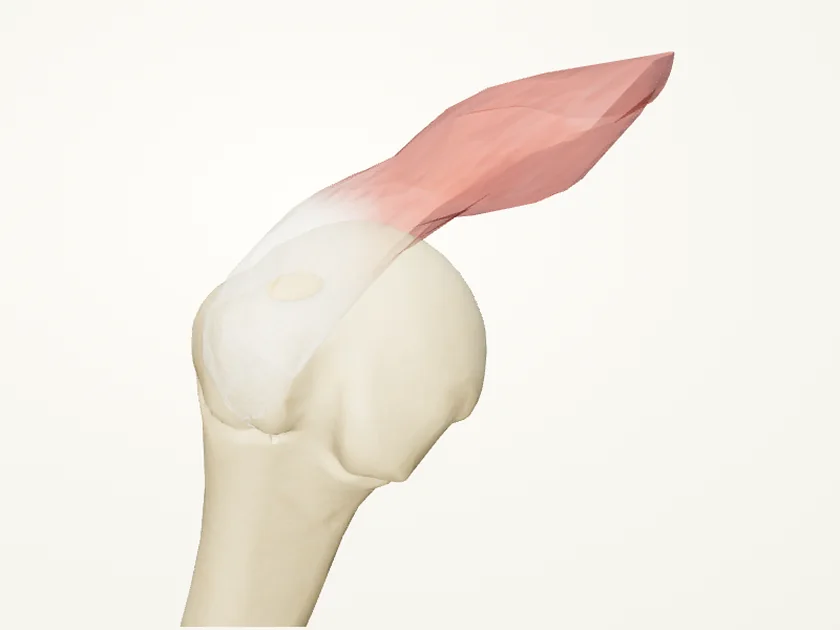
Illustration from the Shoulder Solutions 3D model. The tendon is drawn translucent to show the deposit.
The condition passes through phases. While the deposit is forming and resting, there may be no pain, or a nagging ache like other rotator cuff problems. At some point the body begins to dissolve the deposit. This resorptive phase can cause very severe pain for days to a couple of weeks. It is the worst part for the patient, but it is also the deposit leaving.
Symptoms
- An ache on the outer side of the shoulder, worse on lifting the arm and at night.
- In an acute attack: sudden, intense pain, often with no trigger, and a shoulder that is too sore to move. It can be mistaken for an infection or a fracture.
How it is diagnosed
The deposit shows on a plain X-ray. Ultrasound shows its size and consistency and is used to guide treatment. Deposits are also often seen on X-rays of shoulders that have never hurt, so a deposit is only treated if it fits the symptoms.
Is it all about the calcium?
Not necessarily. The relationship between a deposit and symptoms is looser than the name suggests.
- Most people with rotator cuff pain have no calcium deposit at all.
- Some people have a deposit on their X-ray and no pain.
- In some, the deposit disappears and the shoulder still hurts.
- In others, the pain settles while the deposit is still plain to see.
A deposit can therefore be an incidental finding alongside the more ordinary kind of rotator cuff pain, described in the guide to subacromial shoulder pain. This matters when choosing treatment. Removing a deposit will not help if it was not the cause, and the exercises that help rotator cuff pain in general are worth doing whether or not a deposit is present. Treatment aimed at the deposit itself makes most sense when the symptoms fit: a sizeable deposit, pain at that spot, and above all the sudden severe attacks that are typical of calcium being resorbed.
A trial of 218 patients in Norway and Sweden bears this out.1 Four months after treatment the deposit had disappeared far more often in shoulders that had been washed out (33 of 72) than in those that had not (21 of 136), yet the washed-out group was no better off. Two years on, the deposit had gone in about three quarters of shoulders, in about a third of those without anything having been done to it, and there was no clear difference in shoulder scores between people whose deposit had gone and those in whom it was unchanged.
Treatment
First steps
Anti-inflammatory tablets if you can take them, and keeping the shoulder gently moving. In an acute attack, strong pain relief and a steroid injection into the bursa over the tendon usually bring the pain under control quickly. Exercises help once the pain allows.
For longer-standing pain, the benefit of a steroid injection is short-lived. In the trial described below, people who had one had less pain at two and six weeks than those who had local anaesthetic alone, but the advantage had gone by four months.1
Barbotage
If symptoms persist for some months, the deposit can be treated through a needle under local anaesthetic, guided by ultrasound. The deposit is punctured and, where it is soft enough, washed out with salt water; a steroid injection is given at the same time. It takes about twenty minutes and you go home afterwards. The shoulder is often sore for a few days.
Barbotage has been widely used and is still commonly offered, but the evidence for it has weakened.
An earlier trial of 48 patients found that those who had barbotage with a steroid injection were better at one year than those who had a steroid injection alone.2 At five years the two groups were doing equally well.3
A larger and more rigorous trial, published in 2023, was the first to compare barbotage with a dummy (sham) procedure.1 It included 218 adults whose symptoms had lasted at least three months, and on average more than two and a half years. They were allocated at random to one of three groups: barbotage with a steroid injection; a sham barbotage with a steroid injection; or a sham barbotage with local anaesthetic only. Everyone was given exercises to do at home, and neither the patients nor the staff assessing them knew which treatment had been given.
- At four months, shoulder scores were no different between the three groups.
- At two years, neither barbotage nor the steroid injection had done better than the sham.
- Side effects were few and mild, and there were no serious complications.
About two thirds of the patients had some further treatment during the two years of the study, most of them after the four-month assessment, which makes the later results harder to interpret, and commentators have cautioned against concluding that barbotage has no role at all.4 Even so, it can no longer be presented as a treatment that reliably speeds recovery. It remains an option to discuss for a persistent, well-defined deposit that fits the symptoms, on the understanding that improvement afterwards may owe as much to time as to the procedure.
Shockwave therapy
Pulses of sound energy applied through the skin can help break up a deposit. It is an alternative for people who prefer to avoid a needle. Several sessions are needed and it can be uncomfortable.
Surgery
Keyhole removal of the deposit is kept for the few people whose symptoms continue despite the treatments above. Recovery takes two to three months and the shoulder can be stiff for a while.
Outlook
Good. In most people the deposit disappears with time, with or without treatment, and the shoulder recovers. It does not lead to arthritis, and it rarely comes back in the same shoulder, though it can occur in the other one.
severe shoulder pain comes with a fever or feeling unwell, or the shoulder is hot and red. An infected joint needs to be ruled out the same day.
Sources
- Moosmayer S, Ekeberg OM, Hallgren HB, et al. Ultrasound guided lavage with corticosteroid injection versus sham lavage with and without corticosteroid injection for calcific tendinopathy of shoulder: randomised double blinded multi-arm study. BMJ 2023;383:e076447. doi:10.1136/bmj-2023-076447.
- de Witte PB, Selten JW, Navas A, et al. Calcific tendinitis of the rotator cuff: a randomized controlled trial of ultrasound-guided needling and lavage versus subacromial corticosteroids. American Journal of Sports Medicine 2013;41:1665-73. PubMed record.
- de Witte PB, Kolk A, Overes F, Nelissen RGHH, Reijnierse M. Rotator cuff calcific tendinitis: ultrasound-guided needling and lavage versus subacromial corticosteroids: five-year outcomes of a randomized controlled trial. American Journal of Sports Medicine 2017.
- Robinson DM, McInnis KC, Rhim HC, Tsitsilianos N. Lavage treatments for calcific rotator cuff tendinopathy. BMJ 2023;383:p2248. doi:10.1136/bmj.p2248.
This guide is for educational purposes only. It is not to be used in place of consultation with a medical professional, and it cannot take account of your own circumstances.