
Understanding your shoulder
Subacromial shoulder pain
Often called impingement, rotator cuff tendinopathy or bursitis: what it is, why it usually settles without surgery, and what helps.
Prepared by Mr Phil Wright, consultant shoulder and elbow surgeon. For educational purposes only.
The short version
Subacromial pain is the commonest cause of shoulder pain in adults. It comes from the rotator cuff tendons and the bursa that lies over them. It is not a sign of damage that will get worse with use, and most people recover with time and exercise. An operation to shave the bone above the tendons was once very common, but good trials have shown that it works no better than a placebo operation, and it is now rarely advised.
What it is
The rotator cuff is a group of four tendons that hold the ball of the shoulder in its socket and help lift and turn the arm. They pass beneath a bony roof formed by the acromion, the tip of the shoulder blade. Between the tendons and that roof lies the bursa, a thin, slippery sac that lets them glide.
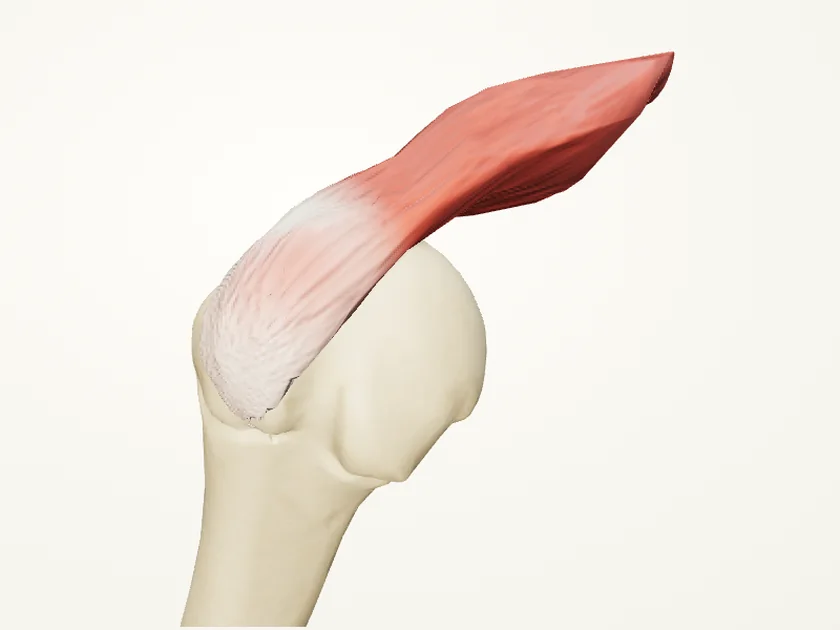
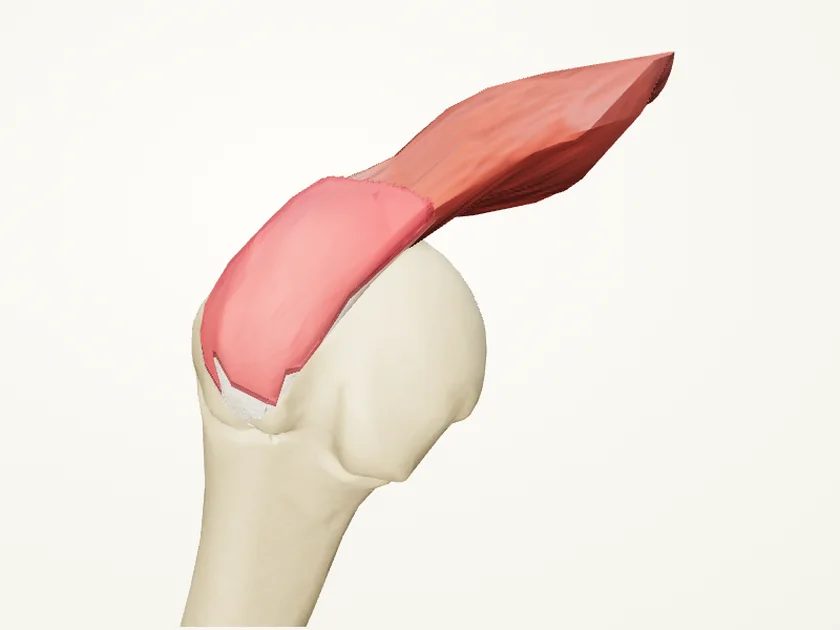
Illustrations from the Shoulder Solutions 3D model. The shoulder blade and collarbone are hidden so the tendon can be seen.
Subacromial pain arises from these tendons and the bursa. It has gone by many names: impingement, bursitis, tendinitis, rotator cuff tendinopathy. The old idea was that the tendons were being pinched against the bone above, which is where "impingement" comes from. It is now thought that the main problem lies within the tendon itself, which has become sensitive and less able to cope with load, and that the shape of the bone matters much less than was believed.
Symptoms
- Pain on the outer side of the shoulder and upper arm, not usually beyond the elbow.
- Pain on lifting the arm out to the side, reaching overhead or behind the back, often through a "painful arc" in mid-range.
- Pain lying on that side at night.
- The shoulder still moves fully, though it hurts to do so. True stiffness suggests a different problem, such as frozen shoulder.
How it is diagnosed
From your story and an examination. An X-ray may be taken to look for arthritis or a calcium deposit. An ultrasound or MRI scan is arranged if a significant tendon tear is suspected, particularly after an injury or if the arm is weak. Scans in people over 50 very often show wear in the tendons that causes no symptoms, so findings have to be interpreted alongside the examination.
What helps
Exercise
A progressive exercise programme, guided by a physiotherapist, is the main treatment. It strengthens the cuff and the muscles around the shoulder blade so the tendon can tolerate more. It needs to be kept up for at least twelve weeks, and some discomfort while exercising is acceptable.
Keep using the arm
Reduce or adapt the things that provoke the pain most, such as repeated overhead work, but do not rest the shoulder completely. Movement does not cause harm.
Pain relief and injection
Simple painkillers or anti-inflammatory tablets help some people. A steroid injection into the bursa can ease pain, which is useful if pain is stopping you sleeping or exercising. How long the relief lasts varies: some people get good relief indefinitely, but this is by no means guaranteed. Those who do best are probably those who use the pain-free period to get on with their exercises, so an injection is a help towards rehabilitation and not a cure. Repeated injections are best avoided. See the guide to shoulder injections.
Surgery
Subacromial decompression is a keyhole operation that removes the bursa and shaves bone from the underside of the acromion. For many years it was one of the commonest shoulder operations.
A UK trial tested it against a placebo operation, in which the surgeon looked inside the shoulder with the camera but removed nothing, and against no surgery at all. It involved 313 patients who had already tried exercise and injection. Six months later, those who had the real operation were no better than those who had the placebo operation. Both surgical groups were slightly better than the group who had no surgery, but by less than patients would notice, and the difference may be explained by the placebo effect or by the physiotherapy that follows an operation.1 A second placebo-controlled trial, in Finland, reached the same conclusion.2
For this reason Mr Wright does not recommend decompression for subacromial pain alone. Surgery still has a place when there is a separate, specific problem, such as a tendon tear that needs repair or a large calcium deposit.
Outlook
Most people improve over three to six months, though it can take a year. Flare-ups are common and usually respond to going back to the exercises.
- the pain began with an injury and the arm is now weak or will not lift
- the shoulder is becoming stiff as well as painful
- you have constant pain at rest, or feel unwell with it
- there has been no improvement after three months of regular exercises
Sources
- Beard DJ, Rees JL, Cook JA, et al. Arthroscopic subacromial decompression for subacromial shoulder pain (CSAW): a multicentre, pragmatic, parallel group, placebo-controlled, three-group, randomised surgical trial. Lancet 2018;391:329-38. PubMed record.
- Paavola M, Malmivaara A, Taimela S, et al. Subacromial decompression versus diagnostic arthroscopy for shoulder impingement: randomised, placebo surgery controlled clinical trial (FIMPACT). BMJ 2018;362:k2860.
This guide is for educational purposes only. It is not to be used in place of consultation with a medical professional, and it cannot take account of your own circumstances.