
Understanding your shoulder
Acromioclavicular joint problems
The small joint on top of the shoulder: arthritis, and injuries from a fall onto the shoulder.
Prepared by Mr Phil Wright, consultant shoulder and elbow surgeon. For educational purposes only.
The short version
The acromioclavicular joint, or AC joint, is where the collarbone meets the shoulder blade, at the bony point on top of the shoulder. Two different problems affect it. Arthritis causes pain on top of the shoulder that usually settles with simple measures. An injury, usually a fall directly onto the shoulder, sprains or tears the ligaments and leaves a bump. Most injuries, including many complete dislocations, recover well without an operation.
The joint
The outer end of the collarbone (clavicle) meets the acromion, the tip of the shoulder blade. The joint itself is small and is held by its own capsule. Two much stronger ligaments, the coracoclavicular ligaments, run from the underside of the collarbone down to the shoulder blade and stop the collarbone riding up.
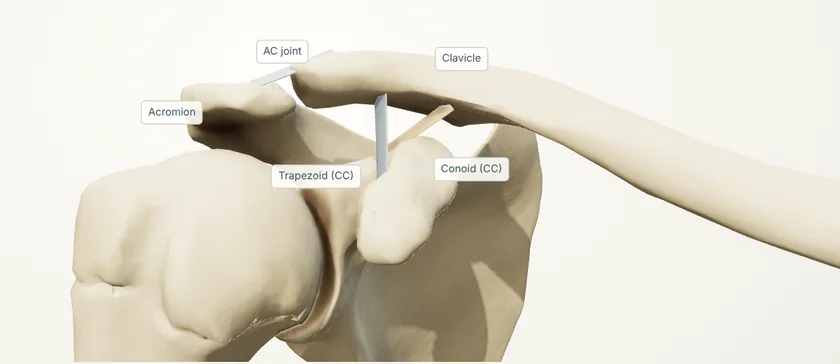
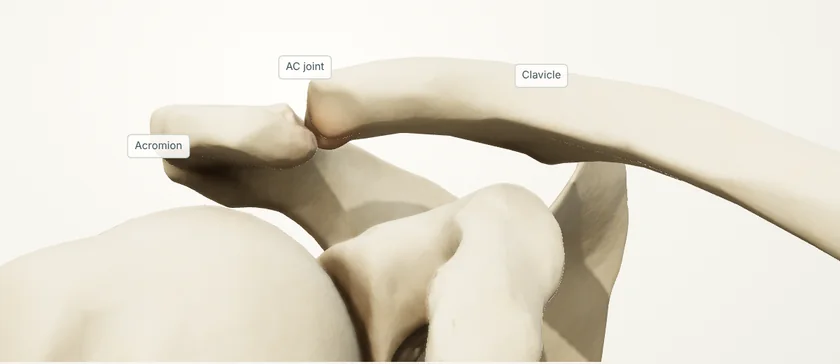
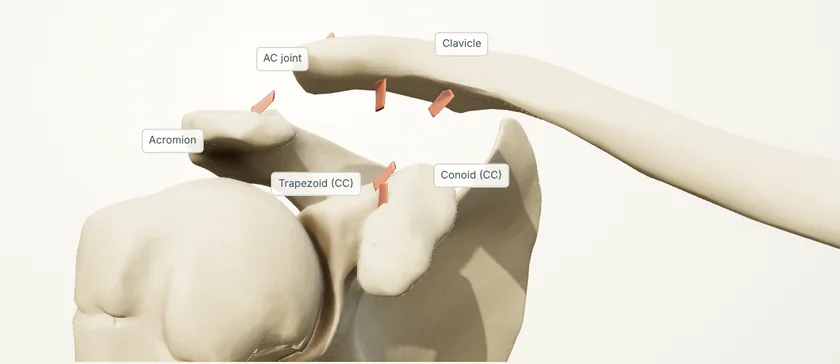
Right shoulder from the front. Illustrations from the Shoulder Solutions 3D model.
Arthritis of the AC joint
Wear of this joint is almost universal with age and is seen on most X-rays after 50. Usually it causes no trouble. It is more likely to be painful in people who have done heavy overhead work or weight training, or who injured the joint years before.
Symptoms
- Pain felt precisely on top of the shoulder, which you can point to with one finger.
- Pain reaching across the body, as when putting on a seat belt or washing the opposite armpit.
- Pain lying on that side, and with press-ups, bench press and dips.
Treatment
- Adjust what provokes it. In the gym, avoid the exercises above for a time, or narrow the grip and limit the depth.
- Anti-inflammatory gel or tablets.
- A steroid injection into the joint. Relief is often good but may be short-lived. It also helps confirm that the joint is the source of the pain.
- Surgery. If pain persists for six months or more despite this, the last few millimetres of the collarbone can be removed through the keyhole so the bone ends no longer rub (AC joint excision). It is a day case, the arm is in a sling for a few days, and recovery takes two to three months. It is considered only when an injection has given clear, if temporary, relief.
AC joint injuries
These follow a fall onto the point of the shoulder, typically from a bike or in contact sport. They are graded by how much the ligaments are damaged and how far the collarbone has moved.
| Grade | What has happened | Usual treatment |
|---|---|---|
| I and II (sprain) | The joint capsule is sprained or torn. The strong ligaments beneath are intact. Little or no bump. | Sling for comfort for one to two weeks, then exercises. Back to sport in two to six weeks. |
| III (dislocation) | All the ligaments are torn and the collarbone sits up, with a visible bump. | Usually without surgery. Sling for two to three weeks, then rehabilitation. Most return to full activity in about three months. |
| IV, V and VI (severe) | The collarbone is widely displaced, or pushed backwards or downwards. | Discussed individually. Surgery is considered more often. |
Does a dislocation need fixing?
Fixing the joint puts the collarbone back in place and removes the bump, but this has not been shown to give a better-working shoulder. A Canadian trial randomly allocated 83 people with complete dislocations to fixation with a plate or to treatment in a sling. Those treated without surgery recovered faster over the first three months, and at one and two years there was no difference in shoulder function. The surgical group had better X-rays but more complications and further operations.1 A later trial of 124 patients found the same.2
For this reason, treatment without surgery is the usual first choice. The bump remains, and is permanent, but in most people the shoulder becomes strong and comfortable. If, after three to six months, the shoulder is still painful or tires easily, the ligaments can be reconstructed at that stage.
When to seek further advice
- After a fall: marked deformity, skin stretched tight over the end of the collarbone, numbness or tingling in the arm, or difficulty breathing.
- Pain on top of the shoulder that has not settled after three months of simple measures.
Sources
- Canadian Orthopaedic Trauma Society. Multicenter randomized clinical trial of nonoperative versus operative treatment of acute acromio-clavicular joint dislocation. Journal of Orthopaedic Trauma 2015;29:479-87.
- Randomised trial of hook plate fixation versus nonoperative treatment for acute Rockwood type III and type V acromioclavicular joint dislocations (124 patients), 2022. Summary.
This guide is for educational purposes only. It is not to be used in place of consultation with a medical professional, and it cannot take account of your own circumstances.